In the latest instalment of our Your Questions Answered series, Strategic Land Group’s Managing Director, Paul Smith, explains how the new Local Plan system works and what landowners need to know.
England’s planning system is supposed to be plan-led - every local authority should have a Local Plan setting out exactly what development will be allowed, and where. In reality, less than 30% of councils actually have an up-to-date plan in place – some authorities haven’t updated it in over 30 years. One of the biggest barriers to delivering the homes we need is the lack of up-to-date Local Plans
Politics is one reason for this. Identifying enough land to meet development needs for the next 15 years is always going to attract opposition, making it challenging for local councillors, many of whom enjoy majorities of just a few dozen votes.
The complexity of the plan-making process is the other main cause. Local plans are long, complex documents dealing with a huge number of issues. While there are some formal steps that councils must take in preparing their documents, there is a lot of flexibility about what is required at each stage and the actions required to get there. That’s why the government has introduced a new process, which is intended to produce more streamlined plans more quickly.
The overall objective of the new-style local plans is the same as those they replace. They should set out how much development is needed over a period of at least 15 years and identify where that development should be located. That is typically achieved by a combination of identifying specific sites for development – usually referred to as “allocations” – and including policies to explain the circumstances in which development would be allowed elsewhere.
Plans are also now required to include a clear vision for development of the area, with no more than ten measurable outcomes to support that vision, and other relevant aims and objectives of the local authority.
The main area of difference to the plans they replace relates to “development management” policies – the detailed policies which apply across the whole plan area and set out general requirements like how to deal with flood risk, heritage impacts or development in the green belt.
Previously, every local plan included its own policies dealing with those issues, typically running to hundreds of pages and taking considerable time and effort to prepare. While they were supposed to reflect national policy, they were inevitably interpreted differently in different authorities, creating a lack of consistency across the country.
The government now intends to introduce one set of “National Decision Making Policies” to be applied everywhere, leaving local plans to focus on where development should be located. The government has, however, yet to publish these new national policies so, for now, local plans will still have to include their own equivalents.
Local Plans now include specific points, known as “Gateways”, where local authorities have to check they are heading in the right direction before carrying on. There is also much greater clarity on what evidence is needed to support the plan, including what data sources to use, and even templates to present that evidence. The intention is to avoid problems arising late in the process that could have been identified – and fixed – much earlier.
The process is described as taking just 30 months – much quicker than the current process – but as the diagram below illustrates, there’s quite a lot of work the councils need to do before that 30-month period starts.
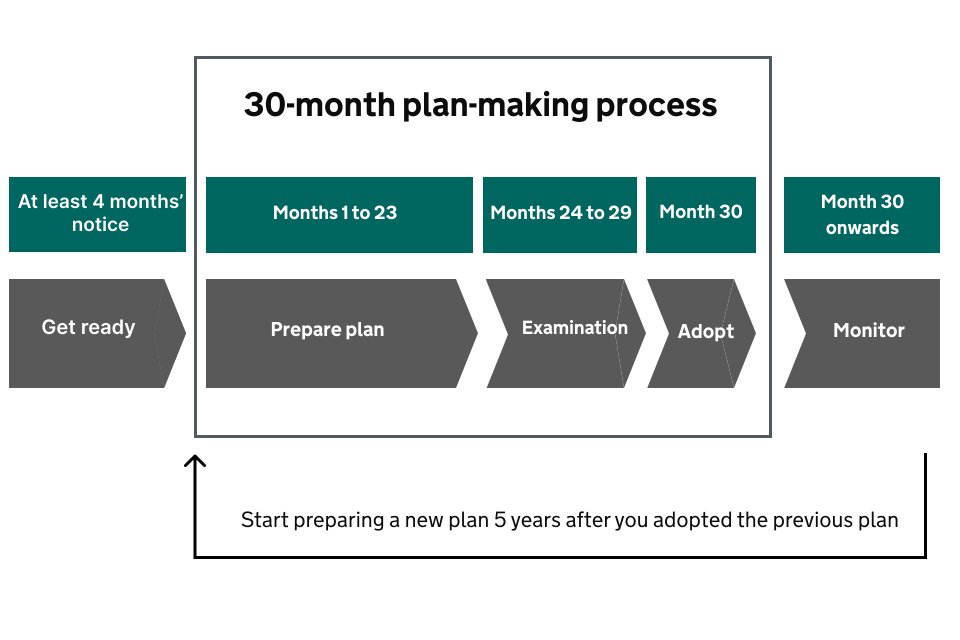
To officially start the plan-making process, councils must give at least four months’ notice by publishing a “notice of intention to commence a local plan” and a timetable for doing so. However, authorities are expected to begin gathering the evidence they will need well before that notice is published.
That evidence should include “baseline” information such as demographic data, past rates of housing delivery, details of transport networks and employment market dynamics. Councils are also expected to start understanding the potential development sites that could be available by running a Call for Sites exercise. You can learn more about the Call for Sites process and its importance for landowners here.
This pre-plan making period must also include a “scoping consultation,” through which the local authority will seek views on what the new Local Plan should include and how local residents and other interested parties should be consulted.
Once that has all been completed, authorities must publish a self-assessment of that work on their website, clearly explaining what they have done and why. This is known as “Gateway 1” – the first of the new series of Gateway checks to ensure plan-making is on-track.
Only once Gateway 1 has been passed does the 30-month process actually begin.
With the process formally underway, local authorities must take all the evidence they have gathered and the feedback from their scoping consultation and prepare an initial draft of the vision for their plan, its aims and objectives and the proposed spatial strategy.
The spatial strategy is an important consideration for landowners. It will set out in broad terms how much development will be located in which parts of the borough. At this stage, that need not mean the specific sites and could just be the proportion of development to be delivered in particular settlements – but it will provide the first clues as to which sites the council is likely to allocate for development.
All of this information will then be consulted on for a period of six weeks, supported by the evidence that the council used to reach those conclusions.
The feedback from that first consultation is then used to produce a first draft of the plan, including a finalised spatial strategy and identifying specific development sites.
At this stage, councils will be expected to pass through Gateway 2. This is the first time the Planning Inspectorate will become involved in the process, appointing a gateway assessor to review the work in progress on the plan and identifying any issues of concern. The assessor will issue their advice and observations to the council in writing, and they must be published on the council’s website.
Local authorities can choose exactly when this stage should take place, but it will be a difficult choice. Start Gateway 2 too early and the plan might not be developed enough for an assessor to give meaningful feedback; leave it too late, and it could increase the amount of abortive work if parts of the plan need to be substantially updated.
Taking the assessor’s feedback into account, the planning authority should then finalise their plan and publish it for an eight week consultation period, along with a policies map and the supporting evidence. The plan will then be finalised before progressing to Gateway 3.
The Planning Inspectorate will again appoint an assessor who, this time, will be tasked with checking the draft plan meets all the necessary requirements from a legal perspective, that it includes the right information, and that the appropriate evidence is available. Once Gateway 3 is passed, the plan moves to the final stage – examination.
The examination process involves a Planning Inspector determining whether the plan is “sound” – essentially that it meets all the relevant legal and planning policy requirements. Reaching that decision requires the appointed inspector to consider all the consultation responses received, and to give interested parties the opportunity to present their views. This will include a series of in-person meetings, known as hearing sessions, where the inspector will seek opinions on various aspects of the plan.
Examination is expected to take six months, at the end of which the Inspector will issue a report confirming whether or not the plan is sound. In some cases, the Inspector may conclude that the plan isn’t sound but could be made so if it were changed. They will then advise the council of those changes and ask for them to be consulted on. Doing so would mean the examination stage lasts longer than six months, however.
Finally, after all that, if the Inspector finds the plan to be sound, all the local authority’s councillors need to vote on whether to “adopt” the plan, bringing it into force and allowing those new policies to be used for deciding planning applications.
Five years after the plan is adopted, the council should start the whole process again, updating and revising their plan to reflect any changed circumstances.
Despite the new terminology, the overall process is very similar to the one that is followed now. The greater clarity over what is needed at each stage, the use of templates, and the earlier involvement of the Planning Inspectorate should all minimise delays during the examination process. As things currently stand, it is not uncommon for the examination stage to be delayed by months or even years while local authorities back-fill missing information or revise their approach to new development.
However, delays at examination are not the only reason the plan-process currently takes so long. The politics of plan-making – especially when there is a change in political control at a council - mean it is not unusual for authorities to continually re-consult on draft plans, or even abandon them and start again, without ever advancing to examination. There is nothing in the new process that would stop that happening, nor any penalties for failing to start plan-making in the first place.
While the new approach offers some improvement, it is unlikely to be the panacea that finally delivers universal plan coverage.


.jpg)